Masha and the Bear: Good Night
- 4.5
- Rating
- 10.00M
- Installs
- Free
- Price

 Analysis by App-foxy
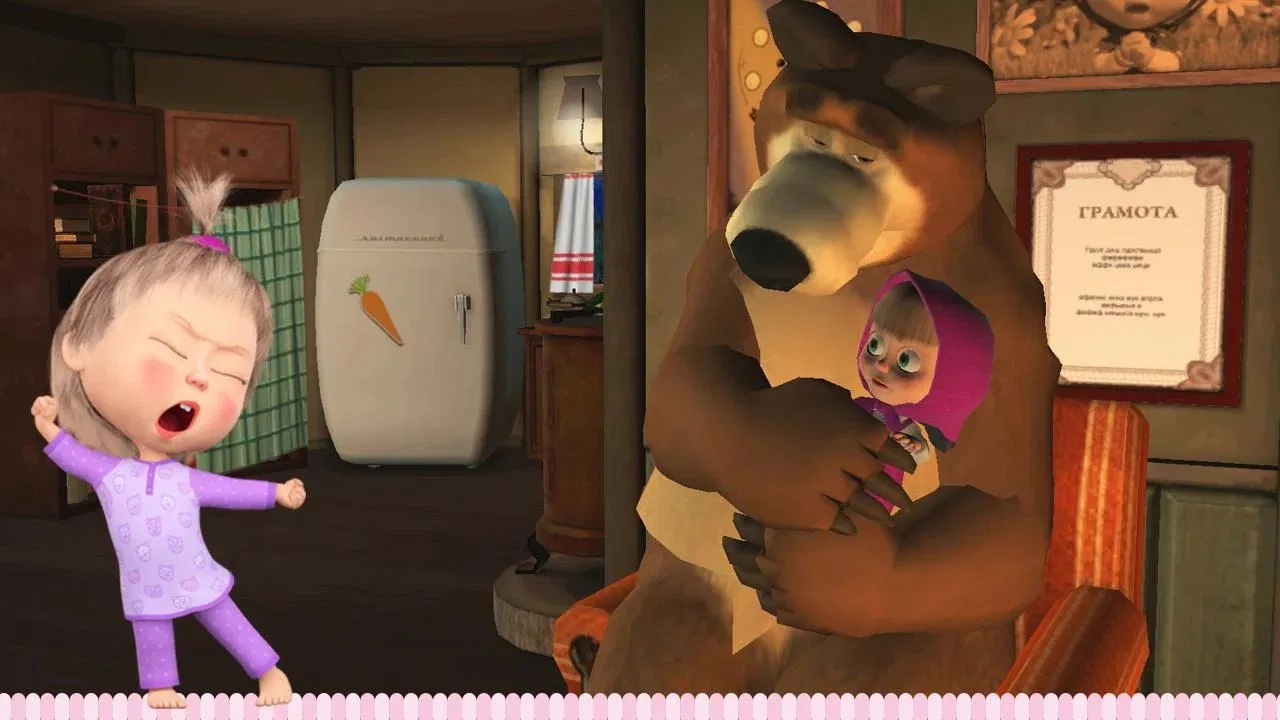
Bedtime games usually have a difficult job: they need to keep a child interested without turning the evening into another burst of noisy screen time. Masha and the Bear: Good Night takes a gentle route, placing Masha and the Bear in a simple bedtime setting rather than asking children to master fast controls or complicated rules. I found it most useful as a short, familiar activity before sleep, especially for younger children who already enjoy these cartoon characters.
This is a free educational game from DTC Lab, rated for Everyone and available for devices running Android 8.0 or later. It has been installed over ten million times and holds a 4.5 average from around sixty-nine thousand ratings, which suggests that the basic idea has connected with a large family audience. The important question, though, is not only whether children recognize Masha and the Bear. It is whether the game gives them enough to do while keeping the mood calm. In my experience, that balance is the main reason to try it, but also the reason some children may outgrow it quickly.
How the bedtime goals work
The early goal is easy to understand: help the cartoon heroes settle down and wish them good night. That simplicity matters for a child who is tired. There is no need to explain a long mission, remember a complicated objective, or compete against a timer. The game presents bedtime as a small routine, and the recognizable characters give that routine an emotional focus that a generic sleep timer or ordinary puzzle may not have.
You May Also Like

 Blood Strike: 2.5 Anniversary
Blood Strike’s Loadouts Turn Every Drop Into a Tactical Gamble
A close look at Blood Strike’s custom loadouts: how fast access to signature weapons reshapes its battle royale rhythm, rewards preparation, and narrows the gap between fights.

 Pandora - Music & Podcasts
Pandora’s Music Is Easy to Start, but Harder to Recover
Pandora’s strength is its low-effort path from a seed to a station. Its weak spot is how much confidence it asks you to place in connection, setup, and quiet recovery.

 8 Ball Pool
 Is Built on Rivalries, Rematches, and Routine
A close look at the rivalries, rematches, shared routines, and unanswered safety questions that turn a quick pool match into a persistent mobile community.

 Samsung Music
’s Quiet Strength Is Playing What You Already Own
Its reach comes less from spectacle than from dependable access to a personal library. That simplicity is both the app’s strongest retention engine and its ceiling.

 AccuWeather: Weather Radar
AccuWeather Review: A Quick, Clear Forecast for Everyday Decisions
For everyday plans, the best forecast is the one you can understand quickly. AccuWeather makes rain timing, radar, and local conditions easy to act on, with a few trade-offs.

 Hill Climb Racing
Why Hill Climb Racing Still Turns Crashes Into One More Run
A tiny car, a bumpy hill and one more upgrade: Hill Climb Racing keeps resurfacing because its simple chaos makes every near-miss feel personal.
More From Our News Desk
View All News


I would introduce it by letting the child explore the first interactions with minimal help. Instead of treating it as a game that must be completed perfectly, I would frame it as a quiet visit with Masha and the Bear. That change in wording makes a real difference: children can concentrate on the sequence and atmosphere rather than feeling that they are being tested. The best use is a brief, supervised wind-down, not an open-ended gaming session.
The educational category is also worth understanding correctly. This is not the kind of learning game that teaches a school subject through lessons and quizzes. Its value is more connected to routine, recognition, following a simple sequence, and practicing the transition from active play to rest. Parents looking for reading exercises, arithmetic, spelling, or structured developmental activities should choose a different app. Parents looking for a familiar bedtime bridge may find this format more suitable.
One practical tip is to keep the same order each evening. Let the child start the game, interact with the characters, and then move directly to the real bedtime routine. Used this way, the game becomes a cue rather than the main event. If the child is allowed to restart repeatedly or use it whenever they want, the calming purpose can disappear. The title works best when the adult decides when it begins and when the screen goes away.
What children notice first
Masha and the Bear are doing much of the communication work. A child who already knows the characters can understand the tone before an adult explains anything. That familiarity is a stronger starting point than an unfamiliar cast, particularly for children who are reluctant to stop playing with toys or watching cartoons. The recognizable setting also makes the activity feel less like an instruction and more like a shared ritual.
The controls are aimed at accessibility rather than challenge. I would not expect a child to spend time learning combinations, planning several moves ahead, or reacting quickly. That is a strength at bedtime because frustration is usually counterproductive. It is also the first sign that this will not satisfy children who want a conventional game with demanding objectives and a strong sense of mastery.
For a younger child, an adult can turn the opening into a conversation: “Who is getting ready to sleep?” or “What would you do before bed?” Those questions add a little language practice and help move the child from passive tapping to understanding the routine. The game supplies the setting, but the parent supplies most of the deeper educational value.
Progress signals, pacing, and the challenge curve
The progression is intentionally soft. Rather than relying on difficult stages, the game appears to communicate progress through the child’s movement through the bedtime scenario and the completion of small interactions. That kind of progress signal is appropriate for the audience because success should feel reassuring. A child does not need a score screen to know that the characters are closer to saying good night.
At the same time, gentle progression can feel thin to an older child. There is a trade-off here: removing pressure makes the experience more comfortable for bedtime, but it also removes the clear rewards that keep children returning to many other educational games. I would expect the strongest engagement from children who enjoy pretend play and familiar characters, not from children who need new levels, increasingly difficult puzzles, or visible collections to stay interested.
The difficulty curve is therefore less about skill and more about attention. The initial interactions are approachable, while the real challenge is encouraging a child to follow the sequence without turning the activity into restless tapping. If a child is very young, an adult may need to demonstrate what to do once. If the child is already comfortable with touchscreen games, the basic interactions may be understood immediately and may not provide much replay challenge.
This is where the game differs from a typical puzzle-based educational title. A puzzle app can build difficulty through more complex patterns, limited attempts, or faster decisions. Masha and the Bear: Good Night is better judged by whether it supports a calm transition. I would choose it over a demanding learning game at the end of the day, but I would choose the puzzle game during daytime play when concentration and challenge are the goal.
Why the pacing matters at bedtime
Fast rewards can make children ask for “one more round.” A bedtime-focused game has to be careful about that pressure. Here, the slower theme and straightforward objective make it easier to stop at a natural point. Still, the presence of a screen can itself become stimulating, especially for a child who is already overtired. I would lower the device brightness, keep the sound comfortable, and avoid handing over the phone as an unsupervised toy.
A useful routine is to play while the child is already in pajamas, rather than using the game as a reason to delay getting ready. That preserves the order of the evening: physical preparation first, quiet digital activity second, and lights out immediately afterward. If the child becomes more excited after playing, that is a clear sign that the app is not helping that particular bedtime, regardless of how gentle its theme feels.
The game can also work during a quiet afternoon for children who need practice with transitions. For example, after a busy family day, I could use it before a nap or after returning home, provided the device is not used as the only way to calm the child. Its strongest role is as one small step in a routine, not as a replacement for reading together, talking, or settling down without a screen.
Unlocks and the reason to return
The retention pressure is modest compared with games built around constant rewards. The appeal comes mainly from revisiting the characters and repeating the bedtime sequence. That can be enough for a child who likes predictable play, and repetition may actually be useful when the goal is establishing a familiar evening pattern. A child does not always need novelty; sometimes the comfort comes from knowing what happens next.
However, parents should not expect a deep unlock system to carry the experience for weeks. If your child asks what new content becomes available after repeated play, this may not be the right kind of game to answer that need. The version available is 1.7.9, and the app is free to download, but optional in-app purchases range from $2.49 to $49.99 per item. I would review any purchase prompts with the child before handing over the device, because a “free” bedtime activity can become less simple when a child starts asking for paid additions.
The purchase range is particularly relevant for families sharing a phone or tablet. I would keep store authentication under adult control and explain clearly that tapping a character or button does not automatically mean something should be bought. This is not a criticism of the bedtime concept itself; it is a practical boundary that helps preserve the app’s role as a calm, predictable activity.
For retention, I prefer to set a limit outside the game. A small kitchen timer, a spoken agreement, or a fixed place in the bedtime routine gives the child a clear ending that the app may not provide on its own. This also prevents the child from measuring success by how long they can remain on the screen. The most useful progress signal is not accumulated play time; it is whether the child can move from the game to sleep without an argument.
Who will enjoy it, and who should skip it?
I would recommend it to families with young children who already respond positively to Masha and the Bear, especially when bedtime transitions are difficult. It is also a reasonable choice for an adult who wants a very approachable first game for a child and does not want fast action, complicated menus, or competitive scoring. The Everyone rating makes its intended audience broad, although a parent should still decide whether the screen and stimulation suit the individual child.
I would be more cautious with children who become fixated on repeating actions, who struggle to stop using devices, or who need substantial challenge to remain interested. For them, the game may either create another negotiation at bedtime or feel too limited after the novelty of the characters fades. An offline storybook, an audio lullaby, or a parent-led routine may be a better choice when the real goal is reducing visual stimulation.
It is also not the best option for a child who wants a complete educational curriculum. The category label should not lead parents to expect lessons in literacy, mathematics, science, or language development. Its learning value is tied to simple interaction and routine. If you want measurable academic practice, select a dedicated learning app; if you want a familiar character-led bridge toward sleep, this game makes more sense.
Compared with a regular cartoon video, the interactive format gives the child a small role instead of making them only watch. That can make the transition feel more personal. Compared with a traditional lullaby app, it offers recognizable characters and a game-like sequence, but it may also invite more touching and visual attention. Compared with a challenging children’s game, it is calmer and easier to start, yet far less satisfying for children who enjoy mastering systems.
Everyday use without turning it into a habit trap
Imagine a child has finished brushing their teeth but is still asking for another cartoon. I would offer this game as the final short activity, sit nearby, and explain that after the characters say good night, the device goes away. Once the sequence ends, I would move straight to the bedroom rather than opening another app. In that situation, the game has a clear job and a clear stopping point.
Another useful approach is shared play for the first few evenings. Watch what the child actually does: do they follow the bedtime sequence, or do they tap randomly and ask to restart? If they engage with the routine, the app may fit. If they become focused on finding more screen time, I would remove it from bedtime and try a non-screen alternative instead. This simple observation is more informative than assuming that a calm-looking game will calm every child.
Parents can also use the characters to reinforce real-world steps. After the game, ask the child to put a toy to bed, choose a book, or say good night to family members. That transfers the pretend routine into the household and prevents the digital activity from becoming an isolated reward. I found this kind of follow-through more valuable than asking the child to play longer in search of extra progress.
My verdict on its progression
As an educational bedtime game, this is deliberately narrow, and that is both its identity and its limitation. DTC Lab has focused on a familiar pair of characters, a simple good-night objective, and a low-pressure pace. The result is approachable for younger children and easy for parents to place inside an existing routine. The game does not need a steep challenge curve to do that job.
Its progression is convincing when measured by comfort and completion: the child understands the goal, moves through a gentle sequence, and reaches a natural bedtime conclusion. It is less convincing when measured by long-term game depth. Children who expect frequent unlocks, increasingly difficult tasks, or substantial educational content will probably find the experience too slight. That is not a flaw to ignore; it is the central trade-off behind the design.
The free entry point makes it easy to test with your child, while the optional purchases mean I would set adult controls before use. The app’s broad reach, 4.5 average, and more than ten million installs show that it has found a substantial audience, but those figures do not replace watching how your own child reacts. Some children settle with familiar repetition; others become more alert whenever a device appears.
My recommendation is therefore specific: try it as a short, supervised bedtime cue if your child likes Masha and the Bear and responds well to predictable routines. Do not choose it as a substitute for a full educational program, a rich long-term game, or a screen-free sleep ritual. Its real strength is not endless play; it is giving a child a gentle, character-led path toward saying good night.
FAQs for Masha and the Bear: Good Night
01What is Masha and the Bear: Good Night about?
Masha and the Bear: Good Night is a child-friendly bedtime app based on the popular animated series. It offers gentle nighttime activities, familiar characters, calming visuals, and simple interactions designed to help children relax before sleeping. Depending on the available version, children may be able to listen to stories, play quiet mini-games, sing lullabies, and follow a soothing bedtime routine with Masha and the Bear.
02Is Masha and the Bear: Good Night suitable for young children?
The app is primarily designed for preschool and early-school-age children, with colorful graphics, recognizable characters, and straightforward controls that do not require advanced reading skills. Parents should still check the age rating shown on Google Play or the App Store, since features and recommendations can vary by version and region. Younger children may benefit from adult supervision during their first sessions.
03Does the app require an internet connection to work?
Some parts of Masha and the Bear: Good Night may work offline after the application has been installed, which is convenient for bedtime use away from Wi-Fi. However, an internet connection can be required for the initial download, updates, advertisements, restoring purchases, or accessing certain online content. It is best to open and test the app before bedtime so you know which activities remain available offline.
04Is Masha and the Bear: Good Night free to download?
The app may be free to download, but availability, advertising, and included content can differ between Android and iOS versions. Some stories, activities, sounds, or additional features may require an in-app purchase or subscription. Before downloading, parents should review the store listing carefully and check the purchase settings on the device to prevent children from accidentally buying optional content.
05Does Masha and the Bear: Good Night contain ads or in-app purchases?
Depending on the edition and platform, the app may include advertisements, optional purchases, or locked content. This is especially important in a bedtime app intended for children, because interruptions can affect the experience and accidental taps may lead to unwanted purchases. Parents should review the app’s privacy, advertising, and payment information, then enable parental controls and supervise use when necessary.
Pros
- Gentle bedtime stories create a calm atmosphere before sleep.
- Simple controls make it easy for young children to use independently.
- Familiar characters help keep preschoolers engaged and comfortable.
- Offline access is useful during travel or in areas without internet.
- Soft visuals and music are suitable for a relaxing nighttime routine.
Cons
- Some content may feel repetitive after frequent bedtime use.
- The app offers limited appeal for children beyond preschool age.
- Audio and animations can still be stimulating for sensitive sleepers.
- Certain features or episodes may require additional purchases.
- Device volume settings need checking to avoid unexpectedly loud playback.

Masha and the Bear: Good Night
Gallery